The Mediator Design Pattern: Centralize Complex Communications
Master the Mediator Pattern in Java. Learn how to reduce coupling by having objects communicate through a mediator instead of directly.
Moshiour Rahman
The Problem: Spaghetti Communication
Imagine a chat application with 5 users. If everyone talks directly to everyone:
- User A → User B, C, D, E
- User B → User A, C, D, E
- …
That’s N × (N-1) = 20 connections for 5 users!
For 100 users: 9,900 connections 💥
Each user needs to know about all other users. Adding/removing users breaks everything.
The Solution: The Mediator Pattern
The Mediator Pattern encapsulates how objects interact. Objects don’t communicate directly; they go through a mediator.
Real-Life Analogy: Air Traffic Control 🛫
Without mediator:
Pilots talk to each other directly:
- “Flight 101 to all planes: I’m landing on runway 3”
- “Flight 202 to all planes: I’m taking off from runway 5”
Chaos! Missed messages, collisions.
With mediator (ATC tower):
- Pilot → Tower: “Request landing”
- Tower → Pilot: “Cleared for runway 3”
- Tower coordinates all planes
Visualizing the Pattern
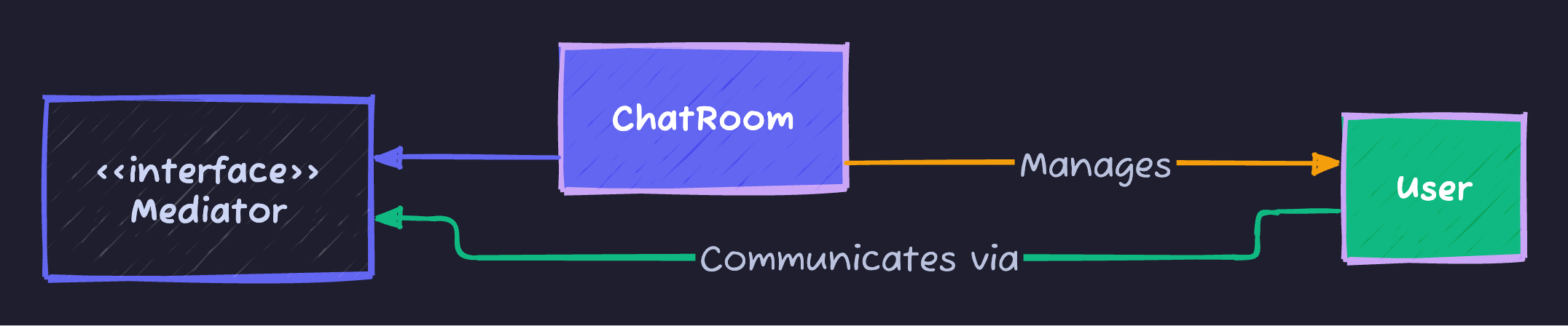
Implementation
1. The Mediator Interface
public interface ChatMediator {
    void sendMessage(String message, User sender);
    void addUser(User user);
}
2. Concrete Mediator
import java.util.ArrayList;
import java.util.List;

public class ChatRoom implements ChatMediator {
    private List<User> users = new ArrayList<>();

    @Override
    public void addUser(User user) {
        users.add(user);
    }

    @Override
    public void sendMessage(String message, User sender) {
        // Broadcast to all except sender
        for (User user : users) {
            if (user != sender) {
                user.receive(message);
            }
        }
    }
}
3. Colleague (User)
public class User {
    private String name;
    private ChatMediator mediator;

    public User(String name, ChatMediator mediator) {
        this.name = name;
        this.mediator = mediator;
    }

    public void send(String message) {
        System.out.println(name + " sends: " + message);
        mediator.sendMessage(message, this); // Delegate to mediator
    }

    public void receive(String message) {
        System.out.println(name + " received: " + message);
    }
}
Usage
ChatMediator chatRoom = new ChatRoom();

User alice = new User("Alice", chatRoom);
User bob = new User("Bob", chatRoom);
User charlie = new User("Charlie", chatRoom);

chatRoom.addUser(alice);
chatRoom.addUser(bob);
chatRoom.addUser(charlie);

alice.send("Hello everyone!");
// Output:
// Alice sends: Hello everyone!
// Bob received: Hello everyone!
// Charlie received: Hello everyone!

bob.send("Hi Alice!");
// Alice received: Hi Alice!
// Charlie received: Hi Alice!
Mediator vs Observer
| Pattern | Communication | Use When |
|---|---|---|
| Mediator | Two-way coordination between colleagues | Complex interactions between objects |
| Observer | One-way notifications (Subject → Observers) | One object needs to notify many |
In The Wild (Real World Examples)
1. Java Swing Event Handling
JFrame acts as a mediator between components:
JButton button = new JButton("Click");
JTextField field = new JTextField();

button.addActionListener(e -> {
    // Mediator coordinates interaction
    field.setText("Button clicked");
});
2. Spring ApplicationEventPublisher
Spring’s event mechanism is a mediator:
@Service
public class OrderService {
    @Autowired
    private ApplicationEventPublisher eventPublisher;

    public void createOrder(Order order) {
        // ... save order...
        eventPublisher.publishEvent(new OrderCreatedEvent(order));
        // Mediator notifies all listeners
    }
}
3. MVC Controller
The Controller is a mediator between Model and View:
@Controller
public class UserController {
    // Mediates between UserService (model) and templates (view)
    @GetMapping("/users")
    public String getUsers(Model model) {
        model.addAttribute("users", userService.findAll());
        return "users"; // View coordinated by mediator
    }
}
Cheat Sheet
| Feature | Details |
|---|---|
| Category | Behavioral |
| Problem Solved | Tight coupling from many-to-many object interactions |
| Key implementation | Central mediator object coordinates all interactions |
| Pros | Decoupling (objects don’t know about each other), Reusability |
| Cons | God Object risk (mediator can become too complex) |
Tips to Remember 🧠
- “ATC Tower”: Planes (objects) talk to tower (mediator), not each other.
- “Spaghetti Buster”: Turns N-to-N connections into N-to-1.
- “MVC”: Controller is a classic mediator example.
Moshiour Rahman
Software Architect & AI Engineer
Enterprise software architect with deep expertise in financial systems, distributed architecture, and AI-powered applications. Building large-scale systems at Fortune 500 companies. Specializing in LLM orchestration, multi-agent systems, and cloud-native solutions. I share battle-tested patterns from real enterprise projects.
Related Articles
The Visitor Design Pattern: Add Operations Without Modifying Classes
Master the Visitor Pattern in Java with practical examples. Add new operations to object structures without modifying existing classes using double dispatch.
JavaThe Observer Design Pattern: Don't Call Us, We'll Call You
Master the Observer Pattern in Java. Learn how to implement event-driven architectures and decouple data sources from listeners.
JavaThe Command Design Pattern: Turning Actions into Objects
Master the Command Pattern in Java. Learn how to encapsulate requests as objects to enable Undo/Redo, queuing, and macro commands.
Comments
Comments are powered by GitHub Discussions.
Configure Giscus at giscus.app to enable comments.