The Iterator Design Pattern: Loop Abstraction
Master the Iterator Pattern in Java. Learn how to access elements of a collection sequentially without exposing its underlying representation.
Moshiour Rahman
The Problem: Exposing Internal Structure
Imagine you have a custom collection class:
class BookShelf {
    private Book[] books = new Book[100];
    private int count = 0;

    public Book getBook(int index) { return books[index]; }
    public int getCount() { return count; }
}
If a client wants to loop through all books, they must:
- Know it’s an array internally.
- Use indices:
for (int i = 0; i < shelf.getCount(); i++).
If you later change the internal storage to a LinkedList, all client code breaks.
The Solution: The Iterator Pattern
The Iterator Pattern provides a way to access the elements of an aggregate object sequentially without exposing its underlying representation.
Real-Life Analogy: TV Remote Channel Surfing 📺
- You don’t know how channels are stored (array? linked list? database?).
- You just press Next and Previous.
- The remote gives you a sequential way to browse without knowing the internals.
Visualizing the Pattern
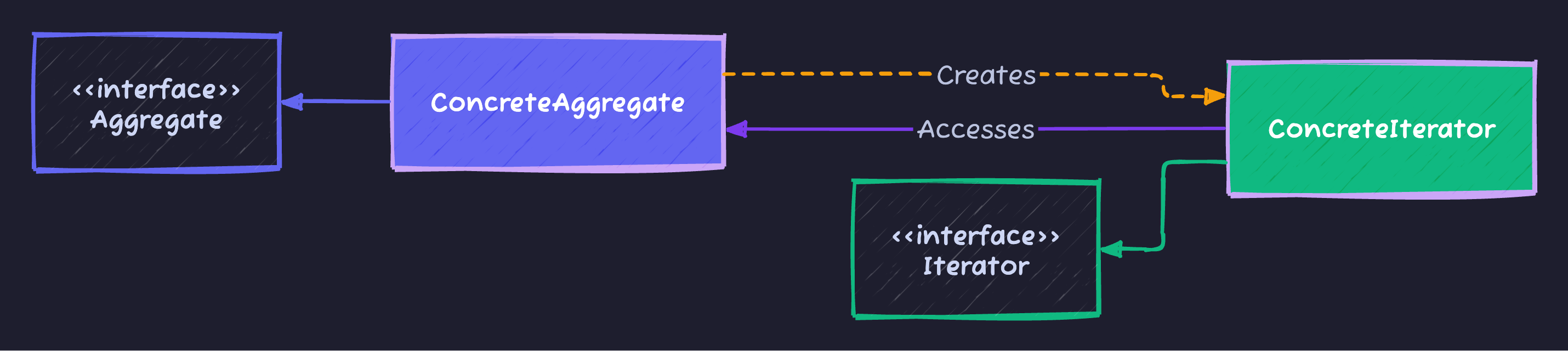
Implementation
1. The Iterator Interface
public interface Iterator<T> {
    boolean hasNext();
    T next();
}
2. The Aggregate Interface
public interface Aggregate<T> {
    Iterator<T> createIterator();
}
3. Concrete Aggregate
public class BookShelf implements Aggregate<Book> {
    private Book[] books = new Book[100];
    private int count = 0;

    public void addBook(Book book) {
        books[count++] = book;
    }

    @Override
    public Iterator<Book> createIterator() {
        return new BookShelfIterator(this);
    }

    // Package-private accessor for the iterator
    Book getBookAt(int index) {
        return books[index];
    }

    int getCount() {
        return count;
    }
}
4. Concrete Iterator
public class BookShelfIterator implements Iterator<Book> {
    private BookShelf shelf;
    private int index = 0;

    public BookShelfIterator(BookShelf shelf) {
        this.shelf = shelf;
    }

    @Override
    public boolean hasNext() {
        return index < shelf.getCount();
    }

    @Override
    public Book next() {
        return shelf.getBookAt(index++);
    }
}
Usage
BookShelf shelf = new BookShelf();
shelf.addBook(new Book("Design Patterns"));
shelf.addBook(new Book("Clean Code"));

Iterator<Book> it = shelf.createIterator();
while (it.hasNext()) {
    Book book = it.next();
    System.out.println(book.getTitle());
}
In The Wild (Real World Examples)
1. java.util.Iterator
Every Java collection implements the Iterator pattern!
List<String> list = Arrays.asList("A", "B", "C");
Iterator<String> it = list.iterator();
while (it.hasNext()) {
    System.out.println(it.next());
}
2. Enhanced For-Loop
The for-each loop is syntactic sugar for the Iterator pattern:
for (String s : list) { ... } // Uses iterator() under the hoodCheat Sheet
| Feature | Details |
|---|---|
| Category | Behavioral |
| Problem Solved | Sequential access without exposing structure |
| Key implementation | hasNext() and next() methods |
| Pros | Encapsulation (Hides internal collection structure) |
| Cons | Overhead (Creating an iterator object for simple cases can be overkill) |
Tips to Remember 🧠
- “Remote Control”: You control traversal without knowing what’s inside.
- “For-Each Magic”: Any class that implements
Iterable<T>can be used in a for-each loop.
Moshiour Rahman
Software Architect & AI Engineer
Enterprise software architect with deep expertise in financial systems, distributed architecture, and AI-powered applications. Building large-scale systems at Fortune 500 companies. Specializing in LLM orchestration, multi-agent systems, and cloud-native solutions. I share battle-tested patterns from real enterprise projects.
Related Articles
The Visitor Design Pattern: Add Operations Without Modifying Classes
Master the Visitor Pattern in Java with practical examples. Add new operations to object structures without modifying existing classes using double dispatch.
JavaThe Template Method Pattern: The Recipe for Success
Master the Template Method Pattern in Java. Learn how to define the skeleton of an algorithm in a superclass but let subclasses override specific steps.
JavaThe Strategy Design Pattern: Kill the If-Else Statements
Master the Strategy Pattern in Java. Learn how to replace complex if-else logic with interchangeable algorithms and follow the Open/Closed Principle.
Comments
Comments are powered by GitHub Discussions.
Configure Giscus at giscus.app to enable comments.