The Facade Design Pattern: The Simple Button for Complex Systems
Master the Facade Pattern in Java. Learn how to hide system complexity behind a simple interface and making your libraries easier to use.
Moshiour Rahman
The Problem: Complexity Overload
Imagine you want to convert a video file. Internally, a video conversion library is complex:
- Read File
- Demux Audio/Video
- Decode Codec
- Resize Frame
- Re-encode
- Mux
- Save File
If you force the client to instantiate all these classes manually, your API is unusable.
// WITHOUT Facade: The Nightmare
Codec codec = new OggVorbisCodec();
CompressionCodec comp = new OggAppMode(codec);
BitrateReader reader = new BitrateReader(buffer, comp);
// ... 20 more lines just to convert a file ...
The Solution: The Facade Pattern
The Facade Pattern provides a simplified interface to a library, a framework, or any other complex set of classes.
Real-Life Analogy: Your Car’s Start Button 🚗
To start a car engine, a lot happens: Ecu checks, fuel injection, spark plug firing, starter motor engagement.
You (the user) don’t do that manually. You just press a button. The “Start Button” is a Facade for the complex engine subsystem.
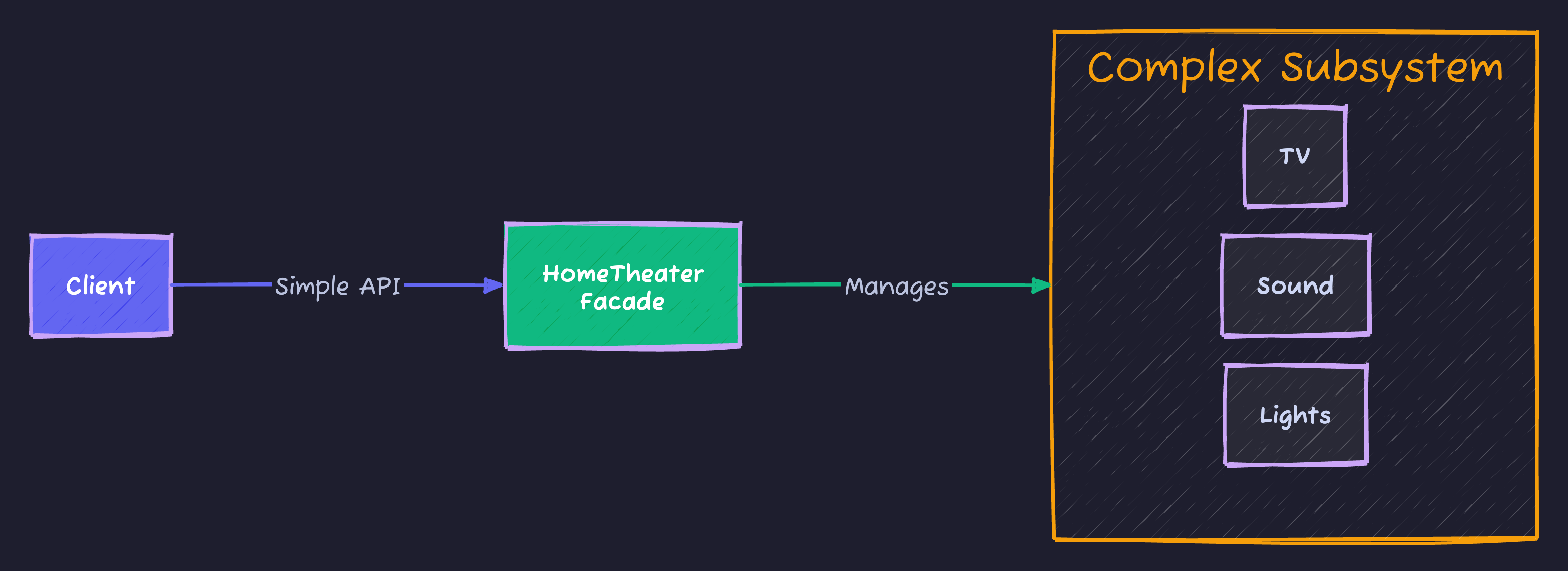
Visualizing the Pattern
Implementation
1. The Complex Subsystem
Let’s say we have a smart home with confusing independent systems.
class Lights {
    public void dim(int level) { ... }
}

class TV {
    public void turnOn() { ... }
    public void setSource(String source) { ... }
}

class SoundSystem {
    public void on() { ... }
    public void setVolume(int vol) { ... }
}

class PopcornPopper {
    public void on() { ... }
    public void pop() { ... }
}
2. The Facade
We create a class that wraps these “ugly” calls into one semantic action.
public class HomeTheaterFacade {
    private Lights lights;
    private TV tv;
    private SoundSystem sound;
    private PopcornPopper popper;

    public HomeTheaterFacade(Lights l, TV t, SoundSystem s, PopcornPopper p) {
        this.lights = l;
        this.tv = t;
        this.sound = s;
        this.popper = p;
    }

    // The Simple Button
    public void watchMovie(String movie) {
        System.out.println("Get ready to watch a movie...");
        popper.on();
        popper.pop();
        lights.dim(10);
        tv.turnOn();
        tv.setSource("HDMI 1");
        sound.on();
        sound.setVolume(20);
        System.out.println("Playing \"" + movie + "\"");
    }

    public void endMovie() {
        System.out.println("Shutting down...");
        popper.off();
        lights.on();
        tv.off();
    }
}
Usage
// Client code is clean
HomeTheaterFacade homeTheater = new HomeTheaterFacade(lights, tv, sound, popper);

homeTheater.watchMovie("Inception");
// ... Later ...
homeTheater.endMovie();
In The Wild (Real World Examples)
1. SLF4J (Simple Logging Facade for Java)
As the name implies! It is a facade that sits in front of Log4j, Logback, or java.util.logging. You code against the simple SLF4J interface, and it manages the complex underlying logging system.
2. Spring JdbcTemplate
The JDBC API is verbose (open connection, create statement, handle loop, catch SQL exception, close connection). JdbcTemplate is a Facade (and a Template) that hides all that complexity behind jdbcTemplate.query().
Cheat Sheet
| Feature | Details |
|---|---|
| Category | Structural |
| Problem Solved | High complexity & coupling to subsystem classes |
| Key implementation | A wrapper class with simple methods (start(), stop()) |
| Pros | Decouples users from subsystem, improves readability |
| Cons | The Facade can become a “God Object” coupled to everything |
Tips to Remember 🧠
- “Front Desk”: A hotel front desk is a facade. You don’t talk to the housekeeping staff, the kitchen, or the maintenance crew. You talk to the front desk.
- API Design: Whenever you write a library, always provide a Facade (a main entry point) for the 90% common use case.
Moshiour Rahman
Software Architect & AI Engineer
Enterprise software architect with deep expertise in financial systems, distributed architecture, and AI-powered applications. Building large-scale systems at Fortune 500 companies. Specializing in LLM orchestration, multi-agent systems, and cloud-native solutions. I share battle-tested patterns from real enterprise projects.
Related Articles
The Visitor Design Pattern: Add Operations Without Modifying Classes
Master the Visitor Pattern in Java with practical examples. Add new operations to object structures without modifying existing classes using double dispatch.
JavaThe Template Method Pattern: The Recipe for Success
Master the Template Method Pattern in Java. Learn how to define the skeleton of an algorithm in a superclass but let subclasses override specific steps.
JavaThe Strategy Design Pattern: Kill the If-Else Statements
Master the Strategy Pattern in Java. Learn how to replace complex if-else logic with interchangeable algorithms and follow the Open/Closed Principle.
Comments
Comments are powered by GitHub Discussions.
Configure Giscus at giscus.app to enable comments.