The Bridge Design Pattern: Decouple Abstraction from Implementation
Master the Bridge Pattern in Java with practical examples. Learn how to avoid class explosion by separating abstraction from implementation hierarchies.
Moshiour Rahman
The Problem: Class Explosion
Imagine you have Shapes (Circle, Square) and Colors (Red, Blue).
With inheritance, you’d have:
RedCircle,BlueCircleRedSquare,BlueSquare
Now add Green. You need 2 more classes.
Add Triangle. You need 3 more classes.
2 shapes × 3 colors = 6 classes
10 shapes × 10 colors = 100 classes 💥
This is the “Cartesian product problem.”
The Solution: The Bridge Pattern
The Bridge Pattern separates abstraction (Shape) from implementation (Color) so they can vary independently.
Real-Life Analogy: TV Remote 📺
- Remote (Abstraction): Buttons like “Volume Up”, “Channel Change”
- TV (Implementation): Sony, Samsung, LG
The same remote works with any TV brand because it uses a standard interface (IR signal, HDMI-CEC).
You don’t need a separate remote for every TV model.
Visualizing the Pattern
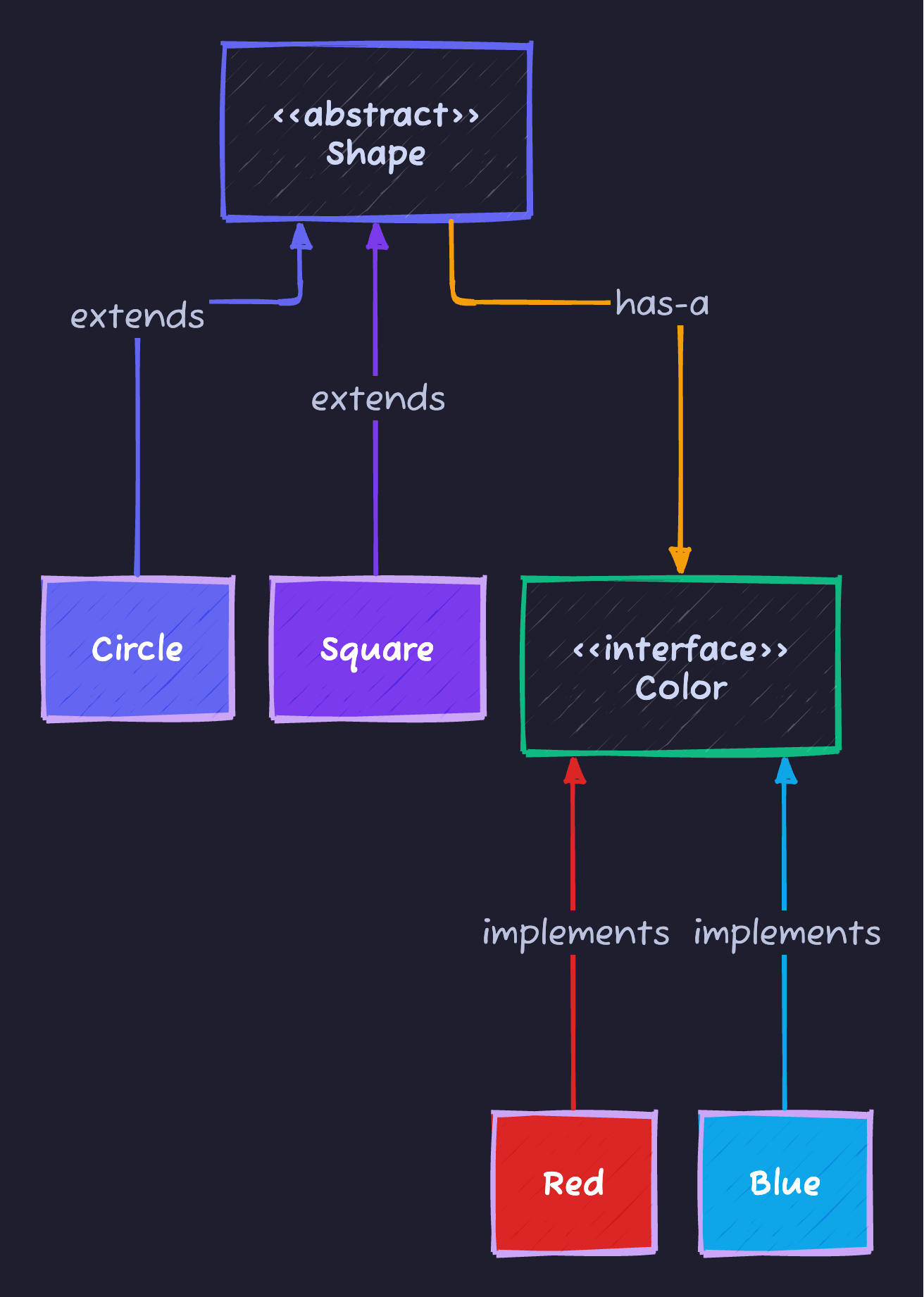
Implementation
1. The Implementation Interface
// The "Implementation" side (Color)
public interface Color {
    void applyColor();
}
2. Concrete Implementations
public class Red implements Color {
    @Override
    public void applyColor() {
        System.out.print("Red ");
    }
}

public class Blue implements Color {
    @Override
    public void applyColor() {
        System.out.print("Blue ");
    }
}
3. The Abstraction
// The "Abstraction" side (Shape)
public abstract class Shape {
    protected Color color; // Bridge to implementation

    public Shape(Color color) {
        this.color = color;
    }

    public abstract void draw();
}
4. Refined Abstractions
public class Circle extends Shape {
    public Circle(Color color) {
        super(color);
    }

    @Override
    public void draw() {
        color.applyColor();
        System.out.println("Circle");
    }
}

public class Square extends Shape {
    public Square(Color color) {
        super(color);
    }

    @Override
    public void draw() {
        color.applyColor();
        System.out.println("Square");
    }
}
Usage
// Composition, not inheritance
Shape redCircle = new Circle(new Red());
redCircle.draw(); // Output: Red Circle

Shape blueSquare = new Square(new Blue());
blueSquare.draw(); // Output: Blue Square

// Add new color? Just add one class!
class Green implements Color { ... }

// Add new shape? Just add one class!
class Triangle extends Shape { ... }

// No explosion: 10 shapes + 10 colors = 20 classes (not 100!)
In The Wild (Real World Examples)
1. JDBC Driver
Abstraction: Connection, Statement, ResultSet
Implementation: MySQL, PostgreSQL, Oracle drivers
// Same code works with any database
Connection conn = DriverManager.getConnection(url);
Statement stmt = conn.createStatement();
// Implementation is bridged at runtime
2. AWT/Swing Peer Architecture
Java’s GUI framework separates:
- Abstraction:
Button,TextField(platform-independent) - Implementation: Platform-specific peer (Windows, Mac, Linux)
Bridge vs Adapter
| Pattern | Purpose | When |
|---|---|---|
| Bridge | Decouple abstraction from implementation during design | You control both sides |
| Adapter | Make incompatible interfaces work after design | Integrating 3rd-party code |
Cheat Sheet
| Feature | Details |
|---|---|
| Category | Structural |
| Problem Solved | Class explosion from multiple dimensions of variation |
| Key implementation | Composition over inheritance (has-a not is-a) |
| Pros | Scalability (add dimensions independently), Open/Closed Principle |
| Cons | Complexity (more classes initially) |
Tips to Remember 🧠
- “Remote + TV”: Remote is abstraction, TV is implementation. They vary independently.
- “Prefer composition”: This is the ultimate example of “composition over inheritance.”
- “2D to 1D”: Turns a 2D matrix of classes (M×N) into 1D (M+N).
Moshiour Rahman
Software Architect & AI Engineer
Enterprise software architect with deep expertise in financial systems, distributed architecture, and AI-powered applications. Building large-scale systems at Fortune 500 companies. Specializing in LLM orchestration, multi-agent systems, and cloud-native solutions. I share battle-tested patterns from real enterprise projects.
Related Articles
The Decorator Design Pattern: Dynamic Superpowers
Master the Decorator Pattern in Java. Learn how to add features to objects dynamically without inheritance explosions. The ultimate 'Wrapper' pattern.
JavaThe Visitor Design Pattern: Add Operations Without Modifying Classes
Master the Visitor Pattern in Java with practical examples. Add new operations to object structures without modifying existing classes using double dispatch.
JavaThe Observer Design Pattern: Don't Call Us, We'll Call You
Master the Observer Pattern in Java. Learn how to implement event-driven architectures and decouple data sources from listeners.
Comments
Comments are powered by GitHub Discussions.
Configure Giscus at giscus.app to enable comments.