The Abstract Factory Pattern: Families of Objects
Master the Abstract Factory Pattern in Java. Learn how to create families of related objects without specifying their concrete classes.
Moshiour Rahman
The Problem: Inconsistent Families
Imagine you are building a UI framework. You support Light Mode and Dark Mode.
- Light Mode: White Buttons, Black Text.
- Dark Mode: Black Buttons, White Text.
You need to ensure that a DarkButton is never used with LightText. They must be created as a Family.
If you use new LightButton() everywhere, your code is messy. Mixing them up leads to ugly UIs.
The Solution: The Abstract Factory
The Abstract Factory Pattern produces families of related objects. It’s a “Factory of Factories”.
Real-Life Analogy: A Furniture Factory 🪑
- Victorian Factory: Makes
VictorianChairandVictorianSofa. - Modern Factory: Makes
ModernChairandModernSofa.
When you order from the “Modern Factory”, you are guaranteed that the Chair and Sofa will match.
Visualizing the Pattern
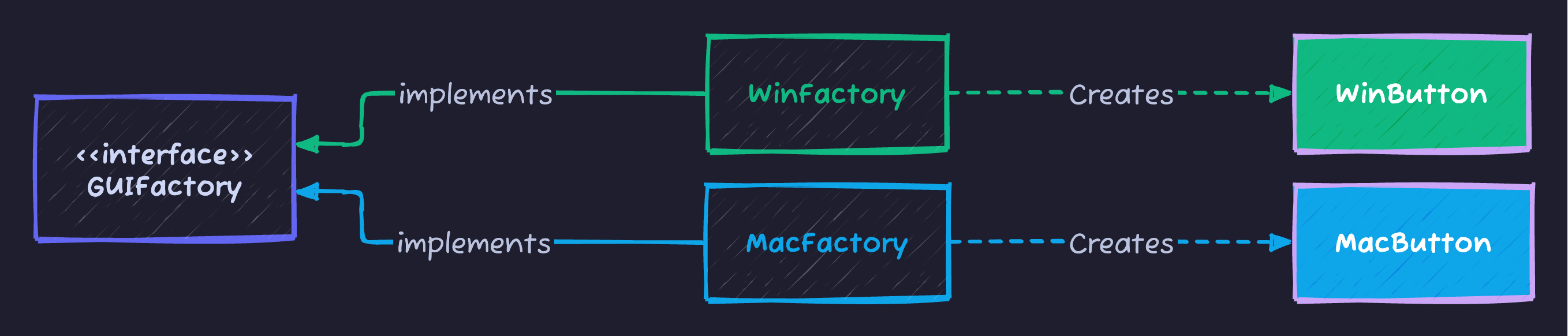
Implementation
1. Abstract Products
interface Button { void paint(); }
interface Checkbox { void paint(); }
2. Concrete Products
// Windows Family
class WinButton implements Button {
    public void paint() { System.out.println("WinButton"); }
}
class WinCheckbox implements Checkbox {
    public void paint() { System.out.println("WinCheckbox"); }
}

// Mac Family
class MacButton implements Button {
    public void paint() { System.out.println("MacButton"); }
}
class MacCheckbox implements Checkbox {
    public void paint() { System.out.println("MacCheckbox"); }
}
3. The Abstract Factory Interface
public interface GUIFactory {
    Button createButton();
    Checkbox createCheckbox();
}
4. Concrete Factories
public class WinFactory implements GUIFactory {
    public Button createButton() { return new WinButton(); }
    public Checkbox createCheckbox() { return new WinCheckbox(); }
}

public class MacFactory implements GUIFactory {
    public Button createButton() { return new MacButton(); }
    public Checkbox createCheckbox() { return new MacCheckbox(); }
}
Usage
public class Application {
    private Button button;
    private Checkbox checkbox;

    public Application(GUIFactory factory) {
        // We don't know if it's Windows or Mac, but we know they match!
        button = factory.createButton();
        checkbox = factory.createCheckbox();
    }

    public void paint() {
        button.paint();
        checkbox.paint();
    }

    public static void main(String[] args) {
        GUIFactory factory;
        String os = System.getProperty("os.name").toLowerCase();

        if (os.contains("win")) {
            factory = new WinFactory();
        } else {
            factory = new MacFactory();
        }

        Application app = new Application(factory);
        app.paint();
    }
}
In The Wild (Real World Examples)
1. JDBC Connection
When you load a driver (Connection, Statement, ResultSet), they are a family. You can’t use a MySQL Connection with an Oracle Statement. The DriverManager acts as a coordinator for these families.
2. Document Builders (XML Parsing)
DocumentBuilderFactory.newInstance() returns a factory that produces parsers (DocumentBuilder) compatible with the specific implementation/configuration required.
Cheat Sheet
| Feature | Details |
|---|---|
| Category | Creational |
| Problem Solved | Creating families of related objects (Theme bundles) |
| Key implementation | Interface dealing with multiple products (createA(), createB()) |
| Pros | Consistency (Products always match) |
| Cons | Complexity (Lots of classes), Rigid (Adding a new product type requires changing ALL factories) |
Tips to Remember 🧠
- Factory Method vs Abstract Factory:
- Factory Method: Produces one product.
- Abstract Factory: Produces a family of products.
Moshiour Rahman
Software Architect & AI Engineer
Enterprise software architect with deep expertise in financial systems, distributed architecture, and AI-powered applications. Building large-scale systems at Fortune 500 companies. Specializing in LLM orchestration, multi-agent systems, and cloud-native solutions. I share battle-tested patterns from real enterprise projects.
Related Articles
The Factory Method Pattern: Decoupling Object Creation
Master the Factory Method Pattern in Java. Learn how to loosen coupling in your code by letting subclasses decide which objects to instantiate.
JavaThe Visitor Design Pattern: Add Operations Without Modifying Classes
Master the Visitor Pattern in Java with practical examples. Add new operations to object structures without modifying existing classes using double dispatch.
JavaThe Template Method Pattern: The Recipe for Success
Master the Template Method Pattern in Java. Learn how to define the skeleton of an algorithm in a superclass but let subclasses override specific steps.
Comments
Comments are powered by GitHub Discussions.
Configure Giscus at giscus.app to enable comments.